

 Product List
Product List
Product List
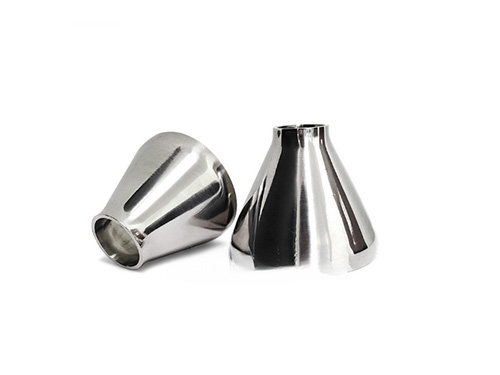
Stainless Steel Reducer
Structural types and selection criteria
Similar to carbon steel reducers, stainless steel reducers are also divided into concentric reducers and eccentric reducers, and the structural differences between the two directly affect their applicable scenarios
1. Concentric reducer
Structural features: The centers of the two ends are on the same straight line, and the inner wall transitions smoothly in a conical shape. The fluid resistance is low (local resistance coefficient is about 0.1-0.2), making it suitable for pipeline systems that are sensitive to pressure loss.
Applicable scenarios:
A straight pipe section for transporting pure liquids (such as water and medicine) and gases (such as compressed air) to reduce medium retention;
Vertical pipelines or horizontal pipelines with no strict restrictions on installation space.
Caution: Avoid using it to transport liquids containing bubbles (such as beverages) or gases containing liquid droplets, to prevent the formation of liquid or gas accumulation areas at the top/bottom.
2. Eccentric reducer
Structural features: The centers of the two ends are not on the same straight line, and there is an eccentricity (usually half of the difference between the diameter of the large end and the small end), which can be installed in two ways: "Flat on Top" and "Flat on Bottom".
Applicable scenarios:
Top level eccentric reducer: must be used for the inlet pipeline of pumps and compressors to avoid equipment cavitation caused by gas accumulation at the top of the pipeline;
Bottom eccentric reducer: suitable for conveying pipelines containing solid particles (such as food raw materials, catalysts) or pipelines that require thorough emptying (such as cleaning pipelines in the pharmaceutical industry) to prevent bottom accumulation.
3、 Manufacturing process and quality control
The manufacturing process of stainless steel reducers needs to take into account material characteristics (such as stainless steel toughness and welding performance). The common processes and requirements are as follows:
Stamping forming
Suitable for small and medium-sized diameters (DN15-DN300), stainless steel plates or pipes are stamped into a conical transition structure through molds to ensure smooth and wrinkle free inner walls and reduce fluid resistance.
Key indicators: Wall thickness deviation ≤ 10%, end face perpendicularity deviation ≤ 1 °, to avoid leakage caused by misalignment during installation.
Welding Forming
Suitable for large diameters (DN300 and above), cutting and welding two sections of stainless steel pipes with different diameters. The weld seam needs to undergo solution treatment (304/316 material heated to 1050 ℃ -1100 ℃ and then water-cooled) to eliminate welding stress and restore corrosion resistance.
Quality requirements: The weld seam must undergo 90% radiographic testing (RT) or penetrant testing (PT) to ensure no porosity or slag inclusion; After welding, the oxide scale of the weld bead needs to be removed, and if necessary, acid pickling and passivation treatment (using nitric acid+hydrofluoric acid solution) should be carried out to restore the surface passivation film (Cr ₂ O3) and enhance corrosion resistance.
Forging processing
Suitable for high-pressure working conditions (such as Class 900 and above), processed with stainless steel forgings (such as 316 forgings), with higher strength and the ability to withstand higher pressures (≤ 30MPa), commonly used in high-pressure pipeline systems in the petrochemical industry.
4、 Application scenarios and selection principles
The selection of stainless steel reducers should be based on the characteristics of the medium, temperature, pressure, and other parameters. The following are typical application cases:
Chemical industry: 316 material eccentric reducer is used for transporting saline water pipelines containing Cl ⁻ (such as chlor alkali plants), resistant to chloride corrosion;
Food and medicine: 304L or 316L concentric reducers, with inner walls electrolytic polished (Ra ≤ 0.8 μ m) to avoid medium residue and bacterial growth, suitable for juice and injection pipeline transportation;
Seawater treatment: 316 eccentric reducer is used for the pump inlet of seawater desalination system, with a flat top design to prevent cavitation and resist seawater corrosion;
High temperature scenario: 321 material concentric reducer is used for boiler steam pipelines (temperature ≤ 600 ℃), resistant to high temperature oxidation and intergranular corrosion;
Low temperature scenario: 304 material reducer is used for connecting pipelines of LNG storage tanks (-196 ℃), utilizing its low temperature toughness to avoid brittle fracture.

+86-15533769121

Jango

jango@yuntaopiping.com

Beixiaozhuangzi Industrial Zone, Mengcun Hui Autonomous County

Copyright © 2025-2026 http://www.yuntaopiping.com. All Rights Reserved Yuntao Piping Group.,Ltd.Copyright