

 Product List
Product List
Product List
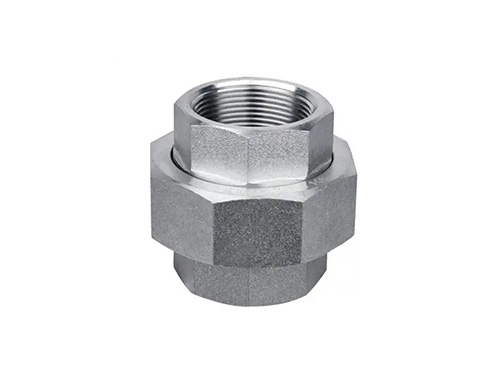
Forged Socket Fitting
Forged Socket Fitting is a socket type pipe fitting produced through forging technology. With its dense material and high strength, it is widely used in medium and high pressure pipeline systems and is a key connector in industries such as chemical, petroleum, and power.
Manufacturing process
Forged socket fittings are made from high-quality steel billets as raw materials. After heating (carbon steel at about 1100 ℃, stainless steel at 1200 ℃), the metal billet is subjected to plastic deformation through a forging press, forming a fitting shape with a socket and a plug. The forging process refines the metal grains, eliminates defects such as porosity and looseness that may occur during casting, and increases the density of the material by more than 30%. After forging, heat treatment (such as normalizing and tempering) is required to eliminate internal stress, ensuring dimensional stability and uniformity of mechanical properties.
Structure and Type
Structurally, one end is a socket (with a step and an inner diameter slightly larger than the outer diameter of the pipeline), and the other end is a socket (with an outer diameter matching the inner diameter of the pipeline), which is positioned through socket fitting. Common types include:
Forged socket elbow (90 °, 45 °): bending radius 1D-1.5D, suitable for turning scenarios with limited space;
Forged socket tee: Both the main and branch pipes are equipped with sockets, and the branching angle is mostly 90 °, suitable for pipes of different diameters;
Forged socket cap: used for sealing pipeline terminals, with a socket depth to ensure a secure connection.
The caliber is concentrated in DN6-DN100, suitable for small and medium-sized high-pressure systems.
Performance advantages
High strength: The tensile strength is 20% -40% higher than that of cast pipe fittings, and the pressure resistance level reaches Class 600 to Class 2500 (10-42MPa), which can be directly used in high-pressure conditions.
Reliable sealing: The processing accuracy of the inner wall of the socket is high (roughness Ra ≤ 1.6 μ m), and it fits tightly with the pipeline, forming a double seal with socket welding (welding foot height ≥ pipeline wall thickness).
Diverse materials: Carbon steel (A105), stainless steel (316L), alloy steel pipe (2.25Cr-1Mo), etc. can be used to meet the needs of different media.
Application scenarios
High pressure mud pipeline of oil drilling platform (A105 forged socket elbow can withstand 16MPa pressure);
The feed branch pipe of the chemical high-pressure reactor (made of 316L corrosion-resistant material);
Lubricating oil pipeline for power plant steam turbine (forged alloy steel pipe fittings resistant to high temperature of 300 ℃).

+86-15533769121

Jango

jango@yuntaopiping.com

Beixiaozhuangzi Industrial Zone, Mengcun Hui Autonomous County

Copyright © 2025-2026 http://www.yuntaopiping.com. All Rights Reserved Yuntao Piping Group.,Ltd.Copyright